
ADVISORY NOTES on Illness and Passing Away in Bali.
Offering general guidance and support to persons dealing with illness and death in Bali, along with a quick reference guide.
These important topics should be discussed with your family/ friends/ executors
SICKNESS:
Create an expandable Emergency A4 File:
Make sure your file contains:
- Your updated medical particulars & major previous treatments. Include allergies and current family doctor.
- Details of any local or EXPAT Medical Health insurance
- Your “Do Not Resuscitate” wishes, if any.
- Your friends and family contact details in Indonesia and overseas.
- Clear copies of all official Indonesian documents and visa/ passport.
- Your medical wishes. ‘The Five Wishes’ might help you clarify these; you can download here. The UK site Home – Compassion in Dying might also be helpful for planning.
To prepare the above, download a blank Personal Information sheet here
Please ensure:
- You keep sufficient Indonesian rupiah in a safe place to access quickly for emergencies.
- You have an up-to-date credit card or debit card to settle doctor and costly hospital bills that must be presented upon entry to the medical facility. Check all bills carefully daily.
- You set aside sufficient rupiah cash to pay monthly living/household costs during your hospitalisation and record who is to have access to such funds,
Resources in case of sickness/accident:
Emergency numbers here
Churches: Protestant & Catholic churches in Bali that provide services in English (expat.or.id) here
1. Car Accident: Immediately contact your insurance agent (have tel no. in car) and prime contact.
1. No reason to die from snakebite – find out what to do if bitten here
1. Mammogram: – Gerba Med Hospital in Kerobokan will do USG Mammogram on appointment at a cost of approx Rp 500k (at time of writing). Prima Medica Hospital give results in 2 hours, approx. Rp900k.
WILLS:
Will preparation and validity
1. Your Will must be up-to-date and in accordance with Indonesian Law.
2. Your Will must be prepared by an Indonesian Lawyer who has experience in such matters.
Will checklist:
Your will should contain the following…
- Refer to jointly or individually held assets of whatsoever kind and wherever held in Indonesia to which you will be entitled or over which you have disposing power at your death, and not to any other assets in any other country.
- Revoke all former wills and testamentary dispositions made relating to any and all assets in Indonesia and appoint a sole Executor or Trustee.
- Give jointly or individually held assets in Bali to the beneficiary only after the deduction of debts, tax, funeral and testamentary expenses, professional fees and other charges deemed necessary at the sole discretion of the Executors, etc.
- Clearly state the beneficiaries for the residual funds from banks, property sales and liquidation of other assets.
- Not be in the form of a Joint WILL, in the case both partners pass at the same time, as these are unacceptable in Indonesia. There must be individual wills by each partner.
While reference can be made to standard will formats in other countries, they may not be considered valid under Indonesian Law. Refer to Write your will – GOV.UK (www.gov.uk) here.
If you lease or otherwise have property assets in Indonesia, you should provide all relevant details, e.g., up-to-date particulars of all such agreements, IMB et,c as attachments to the Will, along with copies of all official documents.
We advise you to consult one or more reputable Indonesian Lawyers for assistance in preparing your Will according to your own particular circumstances.
ADVICE ON BANKING AND BANK ACCOUNTS:
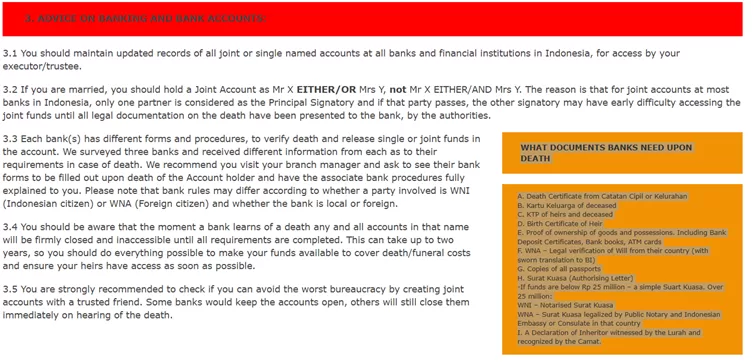
1 You should maintain updated records of all joint or single named accounts at all banks and financial institutions in Indonesia, for access by your executor/trustee.
2 If you are married, you should hold a Joint Account as Mr X OR Mrs Y, not Mr X AND Mrs Y. The reason is that, for joint accounts at most banks in Indonesia, only one partner is considered the Principal Signatory, and if that party passes, the other signatory may have early difficulty accessing the joint funds until all legal documentation on the death has been presented to the bank by the authorities.
3 Each bank has different forms and procedures to verify death and release single or joint funds in the account. We surveyed three banks and received different information from each as to their requirements in case of death. We recommend you visit your branch manager and ask to see their bank forms to be filled out upon the death of the Account holder, and have the associate bank procedures fully explained to you. Please note that bank rules may differ according to whether a party involved is WNI (Indonesian citizen) or WNA (Foreign citizen) and whether the bank is local or foreign.
4 You should be aware that the moment a bank learns of a death any and all accounts in that name will be firmly closed and inaccessible until all requirements are completed. This can take up to two years, so you should do everything possible to make your funds available to cover death/funeral costs and ensure your heirs have access as soon as possible.
5 You are strongly recommended to check if you can avoid the worst bureaucracy by creating joint accounts with a trusted friend. Some banks would keep the accounts open, while others would still close them
Download this sheet here:
WHAT DOCUMENTS BANKS NEED UPON DEATH
A. Death Certificate from Catatan Cipil or Kelurahan
B. Kartu Keluarga of the deceased
C. KTP of heirs and deceased
D. Birth Certificate of Heir
E. Proof of ownership of goods and possessions. Including Bank Deposit Certificates, Bank books, ATM cards
F. WNA – Legal verification of Will from their country (with sworn translation to BI)
G. Copies of all passports
H. Surat Kuasa (Authorising Letter)
-If funds are below Rp 25 million, a simple Suart Kuasa. Over 25 million:
WNI – Notarised Surat Kuasa
WNA – Surat Kuasa legalised by a Public Notary and the Indonesian Embassy or Consulate in that country
I. A Declaration of Inheritor witnessed by the Lurah and recognised by the Camat.
DEATH PLANNING:
1 Make a plan in case of death. This might be just you, or you and your partner at the same time. Consider both options.
2 Discuss funeral particulars & costs with a Funeral Director. Take inflation into account.
3 Consider and plan for quick, easy access to money to pay funeral and associated costs, and to allow your executor some expenditure discretion for non-funeral expenses, e.g. internal travel, villa staff & maintenance expenses, land tax, etc.
4 Remember, if death occurs in the house, a Police Report is required, which might involve time, cost and delay proceedings. Ask the Funeral Director to liaise with the Police and complete formalities in a judicious and cost-effective manner.
5 Expected Death at Home (EDH) is well supported in the west but there is a learning curve here. With EDH, make sure the banjar is aware that someone is ill and will die. When death occurs, DO NOT call the police, who might assume foul play and interrogate the survivors. Call the attending doctor,r who will provide a death certificate, then call the Funeral Home
6 Ibu Cat writes: “I have been in conversation with Dr Krisna at Ubud Care Clinic for several years on the subjects of ageing and dying in the expat community. UCC is very open and forward-thinking. They understand that most of us would prefer to die at home with appropriate pain and anxiety support. “
This is a learning curve here. Morphine is not always available, even for cancer pain management, and the practice is to try to keep people alive at all costs instead of gently assisting in the exit.
It is illegal here to administer morphine and Ativan near death, as is the practice in many Western countries. Ask your hospital if it is possible to release the hospital bed and have the hospital staff carry out their medical duties on the patient at home.
Hospital-assisted care may necessitate the need for police reports if the death occurs at home. Check with your chosen hospital.
7 For Australians – Who to Notify if someone dies part 1 here
8 Read: (2018) Death In Indonesia: What To Do For Expats – What’s New Bali (whatsnewindonesia.com) here.
9 For Australians – Advice for Australian Veterans here
PERSONAL EXPERIENCES:
Please note: This article is for advisory purposes only: BIWA is not responsible for the accuracy of the information on these pages, and cannot be held liable for claims or losses.
Consider joining BIWA – We’d love to say hi…
As a member, you’ll enjoy our monthly luncheons and unlock exclusive discounts across Bali—covering everything from hotels and restaurants to spas, fashion, and groceries. It is a rewarding way to build new friendships and save money, all while directly supporting our community initiatives.